
An autonomous design agent ran four coupled physics simulations (charge transport, optical mode, 3-D RF FDTD, and an analytic loaded-line assembly) in one closed loop and produced ten silicon Mach–Zehnder modulators, each at a different point on the bandwidth-vs-efficiency frontier. Prior agentic demonstrations on this platform exercised one solver at a time. This run coordinates four in a single overnight session.
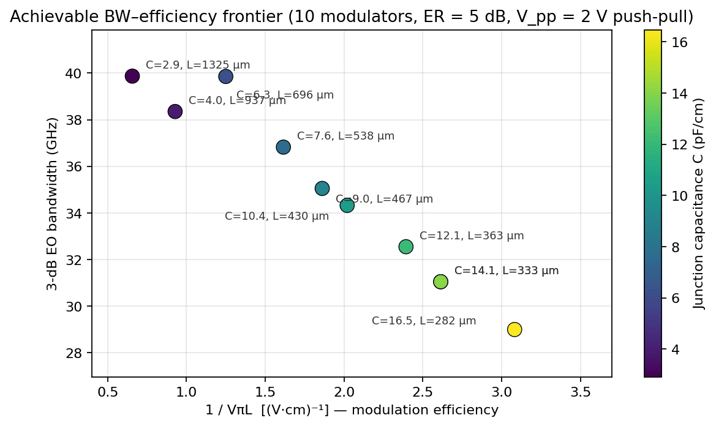
The headline result is the bandwidth-vs-efficiency curve traced out by ten fully optimized devices:
Why a Multi-physics Agent
The two MZM datasheet numbers (bandwidth and VπL) depend on a chain of four physics: charge transport sets junction C(V) and R(V); optical mode solving sets VπL and loss; 3-D RF FDTD sets characteristic impedance Z0, RF group index neff,RF, and electrode losses; and an analytic loaded-line assembly folds all of these into an EO 3-dB bandwidth at a chosen device length and extinction ratio. Earlier blogs covered these solvers individually (RF lines, junction envelope, routing). The new piece is that all four live in the same loop, with the agent moving artifacts between them and keeping the geometry consistent.
The Loop
Two stacked loops share one journal.
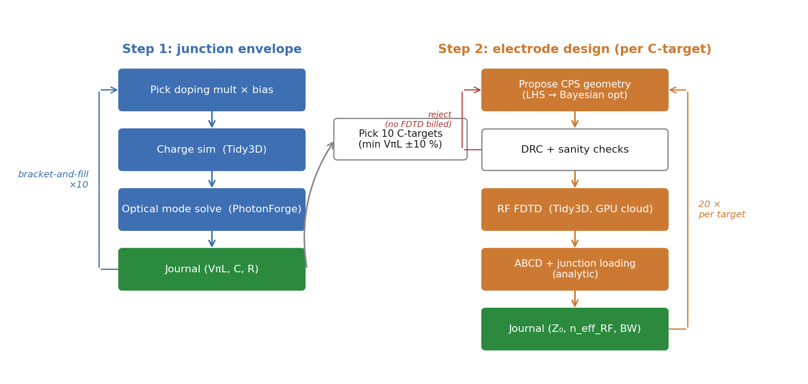
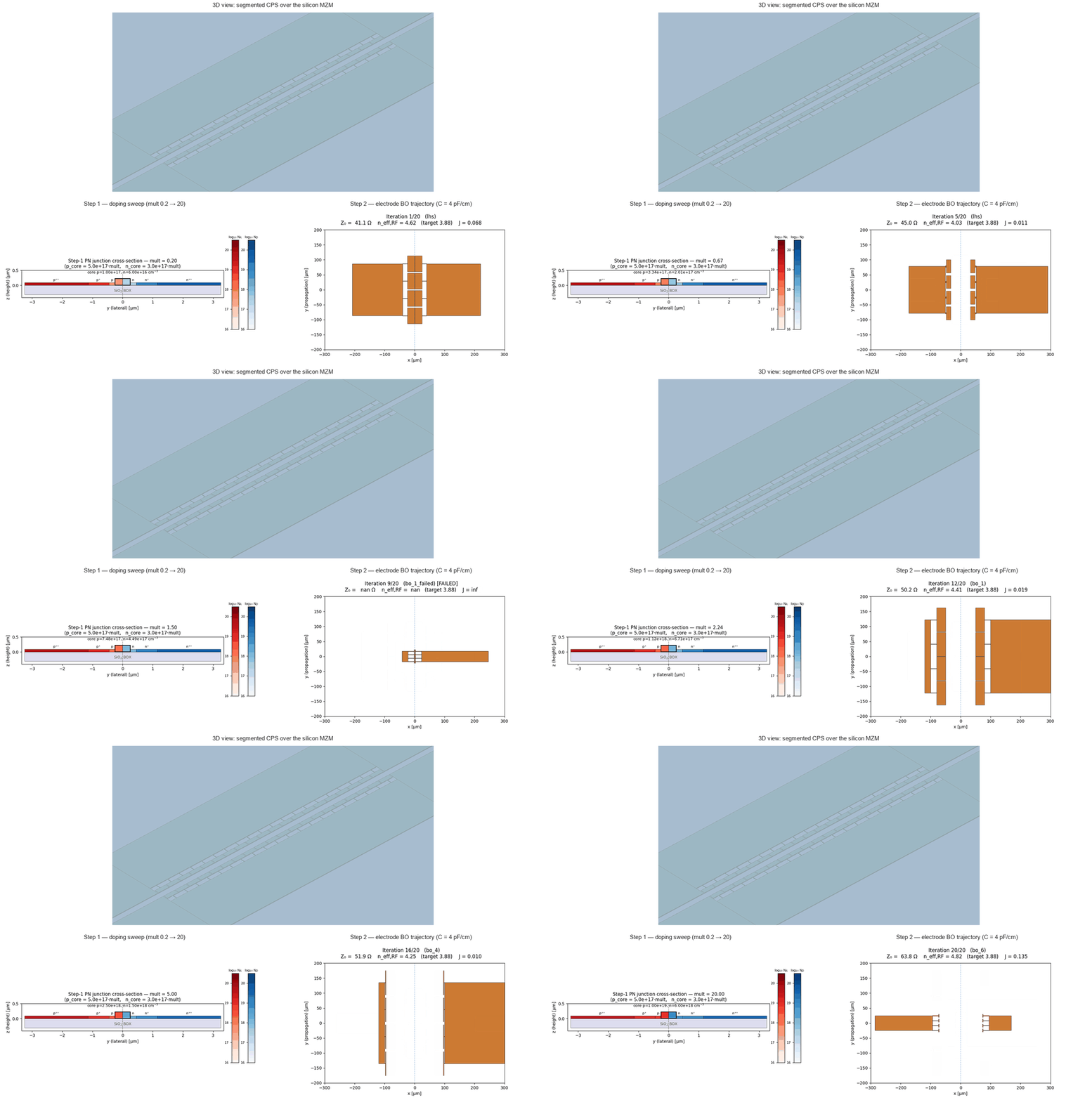
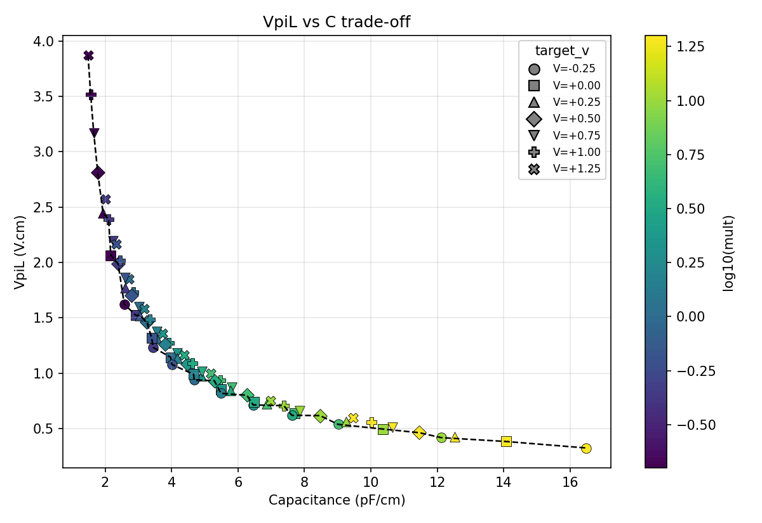
Step 1 (junction envelope). A scalar mult scales p- and n-core doping around the process nominals (p = 5×10¹⁷, n = 3×1017 cm−3 at mult = 1). The agent walks a bracket-and-fill schedule with anchors at mult ∈ {0.2, 1, 5, 20}, inserting new mults at the largest gap on the (VπL, C) frontier. Each mult costs one Tidy3D Charge run plus a mode-solver batch over nine bias points; ten mults cover the cloud:
Step 2 (electrode per operating point). From the Step-1 journal, pick ten capacitance values linearly spaced across the range and, for each, take the row with minimum VπL within ±10 % of that C. Then run an 8-parameter Bayesian optimization on the segmented coplanar-strip electrode (inner gap g, rail widths ws/wg, T-bar s/r, neck h/t, period gap c):
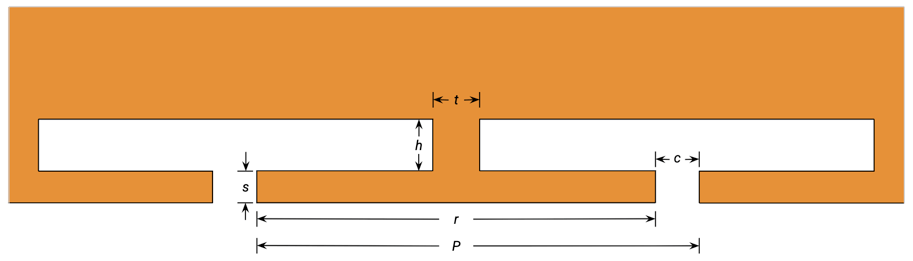
The objective maximizes the analytic 3-dB EO bandwidth, computed by closed-form loaded-line and transfer-function arithmetic. Junction loading is applied after the FDTD via analytic ABCD on the cached Tidy3D S-parameters and the per-V (C, R) record from Step 1.
DRC, Generalized
Following the framing from the routing blog, any rule the computer can check (geometric or physical) is a design-rule check. Before billing a cloud simulation the agent enforces three layers: fab rules (the 8-parameter box bounds; out-of-box BO proposals are rejected at no cost); process rules (heavy contact dopings, waveguide dimensions, and the dielectric stack are frozen); and setup sanity: a 300 μm minimum feedline so the wave port stays ≥2 mesh cells off PML, a sign-flip retry on the de-embedded RF group index (one candidate returned neff = −3.01 and auto-retried with ±2 % perturbation), and a 1.2 GHz Gaussian smoother on the extracted H(f) that caught single-frequency ripples that would otherwise have produced spurious −3 dB crossings a few GHz off.
What the Agent Found
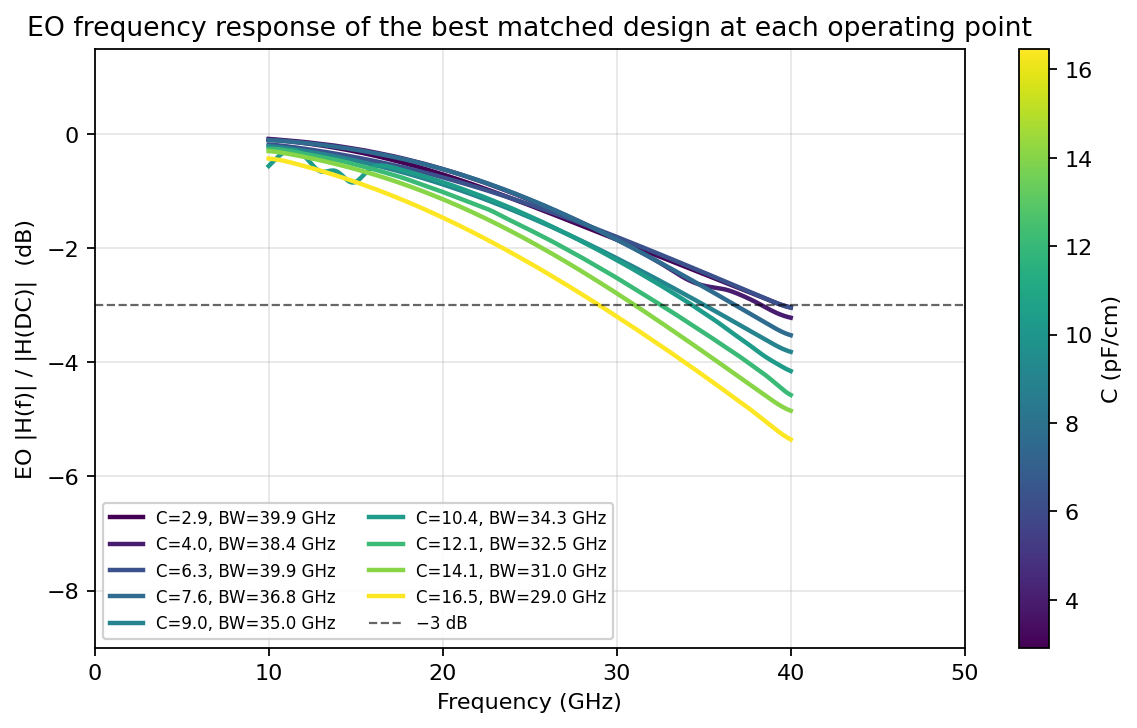
Nine distinct designs (operating point 8 picked the same junction as operating point 7), sorted by efficiency:
| C [pF/cm] | VπL [V·cm] | 1/VπL [(V·cm)⁻¹] | LMZM [μm] | Z0,loaded [Ω] | neff,RF | BW3dB [GHz] |
|---|---|---|---|---|---|---|
| 2.92 | 1.523 | 0.66 | 1325 | 52.2 | 3.79 | 39.9 |
| 4.01 | 1.078 | 0.93 | 937 | 54.1 | 4.40 | 38.4 |
| 6.27 | 0.800 | 1.25 | 696 | 49.2 | 5.75 | 39.9 |
| 7.62 | 0.619 | 1.61 | 538 | 54.9 | 6.67 | 36.8 |
| 9.02 | 0.537 | 1.86 | 467 | 51.0 | 7.16 | 35.1 |
| 10.35 | 0.495 | 2.02 | 430 | 52.2 | 8.24 | 34.3 |
| 12.11 | 0.418 | 2.39 | 363 | 53.0 | 9.40 | 32.5 |
| 14.07 | 0.383 | 2.61 | 333 | 52.6 | 10.71 | 31.0 |
| 16.47 | 0.324 | 3.08 | 282 | 49.1 | 11.35 | 29.0 |
Across all ten operating points the electrode holds Z0,loaded within ±10 % of 50 Ω. At light loading (C < 5 pF/cm) neff,RF lands at 3.8–4.4, well-matched to the 3.88 optical group index, and bandwidth reaches 38–40 GHz on a 0.9–1.3 mm device. At heavy loading (C > 7 pF/cm) the junction's loaded shunt forces neff,RF up to 7–11; bandwidth lands at 29–37 GHz with device length below 540 μm. The bandwidth degrades smoothly with loading, set primarily by velocity walk-off and the junction's intrinsic R·C pole, not by impedance mismatch.
What Was Unexpected
-
The agent offered to optimize bandwidth directly. Halfway through the run, it proposed switching the objective from
((Z₀−50)/50)² + ((n_eff−3.88)/3.88)²to maximizing the analytic 3-dB BW directly. The pivot added +5 to +11 GHz across the heavy-loading half of the curve. -
Cross-evaluation across operating points was free. A single CPS FDTD result depends only on geometry; junction loading is applied analytically afterwards. So every FDTD gave ten data points (one per c_target). 16 hand-picked FDTDs across two design-of-experiments rounds, cross-evaluated, covered the search corners for all ten operating points.
-
One FDTD glitch nearly cost a result. At C = 12.11 pF/cm a single-frequency γ(f) ripple put a spurious 1-dB dip in H(f) at 22 GHz; the smoothing kernel caught it.
What Makes This Different from a Parameter Sweep
-
Four physics in one agent's working memory. The same context that proposed the electrode geometry also picked the Step-1 row, applied the analytic loading, and decided whether the bandwidth was worth the next FDTD. The journal is the only persistent state.
-
Analysis first, simulation second. Before billing each FDTD batch the agent worked the data already in hand. It cross-evaluated every cached geometry against every operating point's junction (free, no cloud spend), derived the (Z0, neff) Pareto slope analytically from the loaded-line equations, and computed an neff floor per c_target from the junction RC time constant. Each of the 16 hand-picked FDTDs in the BW-optimization phase was paired with an explicit physics hypothesis. A blind BO would have spent multiples of the cloud credit chasing the same answer.
-
The result is a frontier, not a point. A device designer picks one modulator off the table; a process engineer reruns the loop on new design rules and re-reads the envelope.
The pattern extends to thermo-optic phase shifters, electro-absorption modulators, ring resonators with active tuning, and any other device whose figure of merit stacks two or more physics solvers on the same geometry.
-1.gif)
-1.gif)