The Intelligent Wave Systems Laboratory at Seoul National University studies wave phenomena in complex and disordered media, connecting the statistical structure of a material with its electromagnetic response. Led by Sunkyu Yu, Associate Professor in the Department of Electrical and Computer Engineering, the group works on wave-based information processing and on engineering disorder as a design resource. Most photonic design assumes that precise control of light requires precise order: periodic lattices built to tolerance. This group is testing how far that assumption actually holds.
"One of our broader goals is to move beyond the conventional idea that precise wave control necessarily requires perfectly periodic structures," explains Ikbeom Lee, a Ph.D. student in the group. "Instead, we are interested in discovering the hidden statistical order within disorder and using quantities such as spatial correlations, material loss, and gain as controllable degrees of freedom." The long-term goal is to establish a set of general design principles that enable tailoring a material's microstructure to achieve a desired scattering, transport, or spectral response.
In their recent work, "Non-Hermitian stealthy hyperuniformity," Ikbeom and his colleagues asked whether hyperuniformity and stealthiness, concepts developed for conventional Hermitian materials, extend to non-Hermitian disordered media containing gain and loss. They found that they do, and that the extension supplies an additional control parameter: correlations between the real and imaginary parts of the material response govern the direction and symmetry of scattering. Using it, the team designed disordered structures with directional scattering responses, including three-fold rotational symmetry and strongly asymmetric scattering patterns that are inaccessible in conventional Hermitian systems.
Designing these structures is a statistical exercise. Confirming that they behave as designed is a demanding full-wave electromagnetics problem. For that validation, Ikbeom turned to Tidy3D and its Python API. He modeled large disordered ensembles of subwavelength cylindrical scatterers with complex refractive indices, illuminated them with a total-field/scattered-field (TFSF) source, swept the incidence direction, and used Tidy3D's far-field angle projector to reconstruct the angular scattering response. In one of the main validation studies, he simulated a structure containing 2,000 gain scatterers and 2,000 loss scatterers. The full-wave results reproduced the designed two-fold and three-fold scattering-suppression symmetries, providing a bridge between the group's statistical scattering theory and realistic electromagnetic simulation.
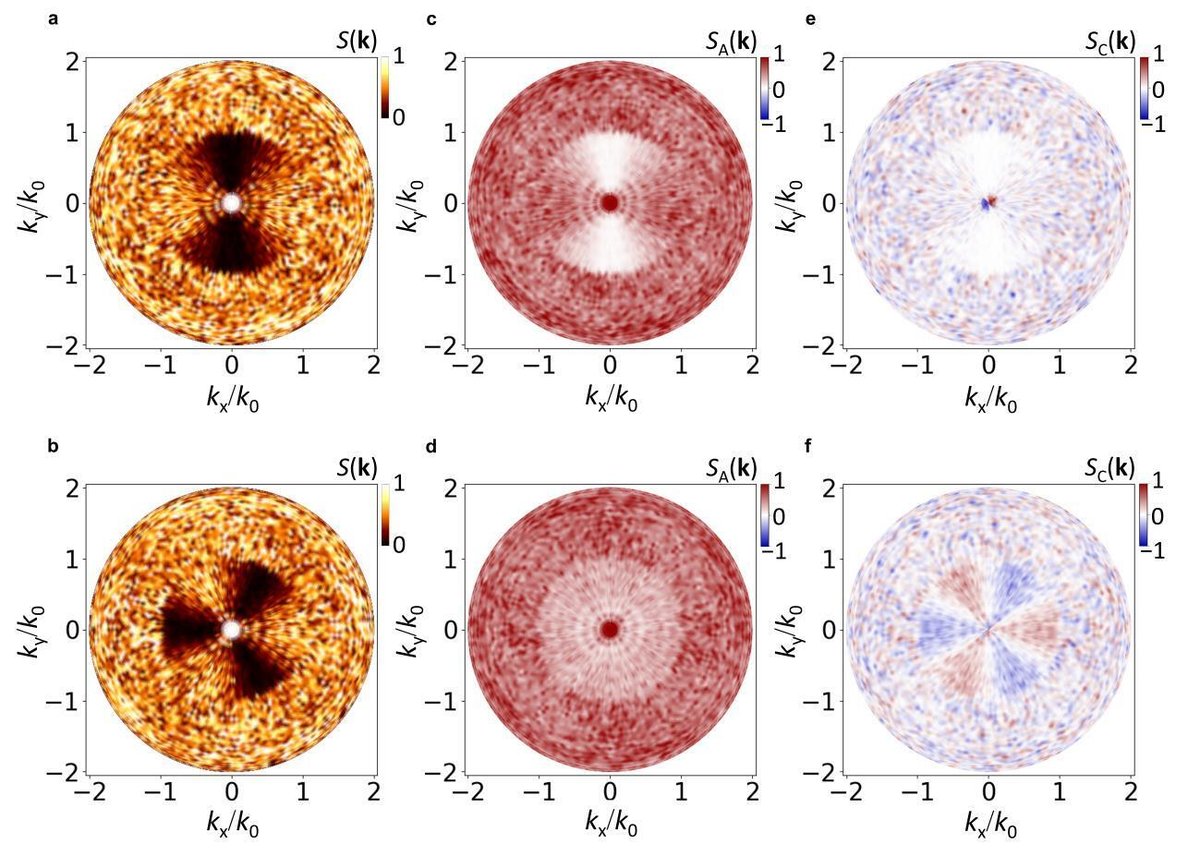
Full-wave validation of the designed scattering response in a medium containing gain and loss. Total structure factor S(k)for the two-fold design (a) and the three-fold design (b), with the corresponding auto-correlation component SA(k) (c, d)and cross-correlation component SC(k) (e, f). Dark regions mark the directions in which scattering is suppressed; SC(k) vanishes in any Hermitian material, so panels e and f show the part of the response that gain and loss make available. Each structure factor is assembled from 120 angles of incidence (0° to 357° in 3° steps) and averaged over five independent realizations. Figures courtesy of Ikbeom Lee and colleagues.
Simulations at that scale are what make the approach workable. "One of the key advantages of Tidy3D for my work is that it makes full-wave simulations of large, irregular, and non-Hermitian structures practical," Ikbeom says. "This is particularly important for my work on disordered systems, where the simulation domain can contain thousands of scatterers rather than a small periodic unit cell." Combining complex-valued material parameters, TFSF excitation, angular sweeps, and far-field projection in a single workflow lets him compare the full-wave scattering response directly against the structure factor predicted by theory, with Tidy3D's batch processing carrying the sweep across incidence angles. That comparison carried real weight because the theoretical framework begins from a weak-scattering approximation. The simulations supplied independent electromagnetic evidence that the designed directionality and rotational symmetries remain visible in a full-wave setting.
Tidy3D also helped move the concept toward a more experimentally practical implementation. Optical gain is difficult to realize in the lab, so Ikbeom tested a passive alternative by replacing gain with appropriately chosen low- and high-loss materials and confirmed through full-wave calculations that the characteristic scattering distributions were preserved.
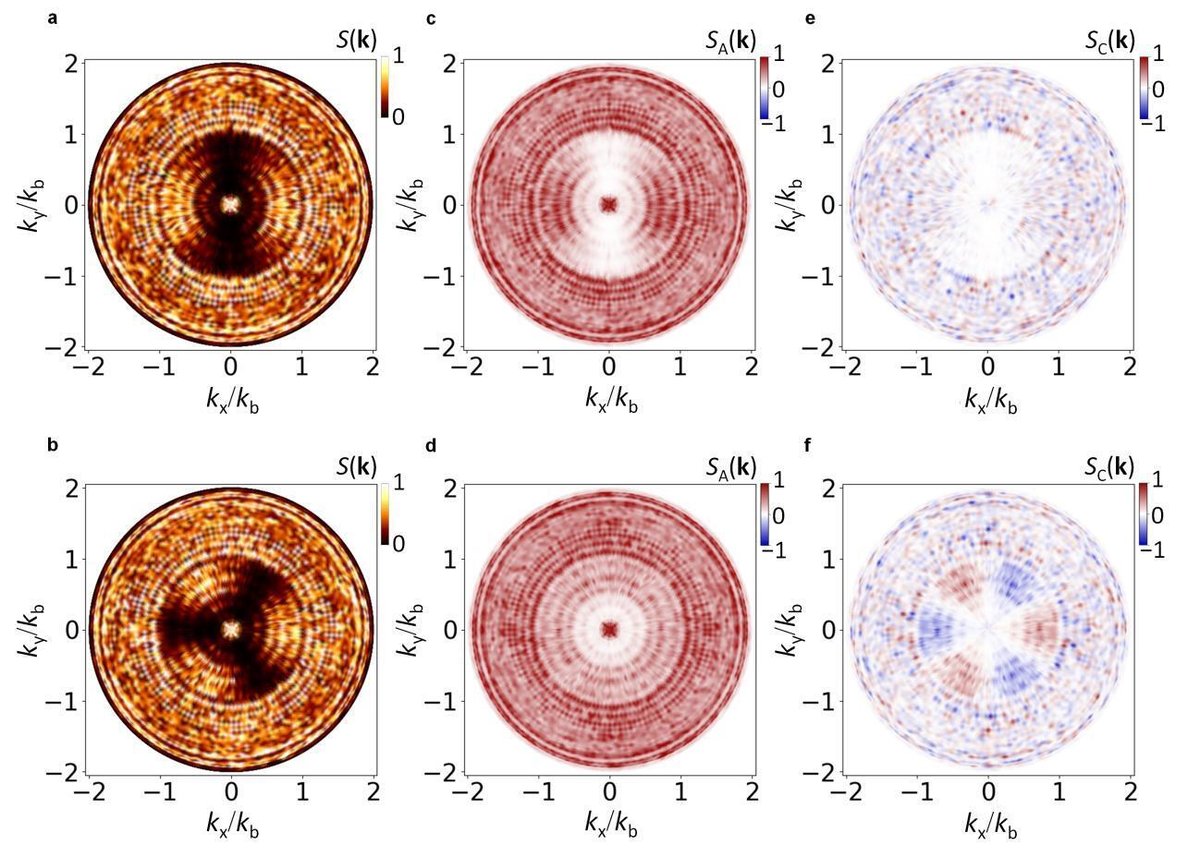
The same scattering responses in a fully passive structure. A gauge transformation trades the gain scatterers for low-loss scatterers in a lossless background, so momentum is normalized to the background wavenumber kb rather than the free-space k0. The two-fold (top row) and three-fold (bottom row) suppression symmetries survive the substitution, with S(k) in(a, b), SA(k) in (c, d), and SC(k) in (e, f).
 |
"I found Tidy3D particularly valuable for scattering analysis, where computational efficiency becomes critical when many incident angles and large disordered structures need to be considered. I also found the batch processing feature incredibly useful. Its speed and flexible far-field analysis allowed me to explore complex scattering responses much more efficiently." — Ikbeom Lee, Seoul National University |
For Ikbeom, what stands out is the workflow rather than any single simulation. "In my experience, the combination of fast FDTD simulations and convenient far-field analysis makes it much easier to turn a complex scattering problem into a systematic computational workflow," he notes, something he expects will be especially valuable to researchers working on disordered photonics, metasurfaces, and other large-scale electromagnetic scattering problems.
As the Intelligent Wave Systems Laboratory continues to map the statistical order hidden inside disordered media, Tidy3D remains a key part of the group's toolkit. Their work also reframes a familiar question in photonic design. Instead of asking how precisely a structure can be built, it asks how much precision a given optical function actually requires, and fast full-wave simulation is what makes such questions answerable.