ty_hero image-2

FAST, MODERN PHOTONIC SIMULATIONS

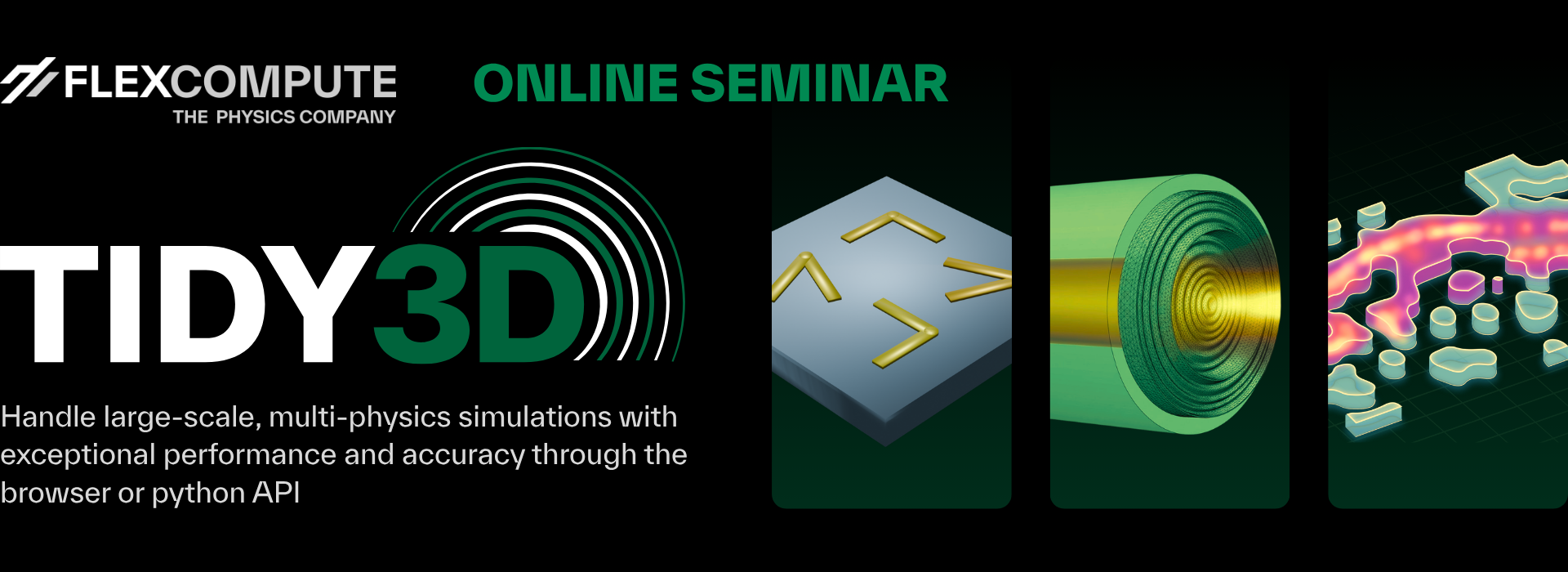
Tidy3D is built to handle large-scale, multi-physics simulations with exceptional performance and accuracy, available through the browser or the Python API. With its high-performance cloud infrastructure, Tidy3D delivers simulation results in minutes rather than hours or days, enabling engineers and researchers to rapidly iterate, explore design spaces, and accelerate innovation.

The New Era of Photonic Design - Agentic Design Automaton

With the introduction of FlexAgent MCP, this design workflow becomes even more powerful. More than a chatbot, FlexAgent is a physics-aware AI assistant designed specifically for photonic design, helping users navigate complex tasks, automate workflows, and accelerate iteration with intelligent, context-aware guidance.


WHO SHOULD ATTEND

  • Researchers & Academics
    Explore modern methods for simulating complex nanophotonic systems and support your research and publications.

  • Graduate Students & Postdocs
    Build practical simulation skills, automate workflows, and accelerate your research.

  • Educators
    Find easy and effective ways to bring photonics concepts into the classroom with intuitive simulations.


REWARDS FOR ATTENDING
  • Attending a seminar gains 💰 50 FlexCredits

  • Run 5 simulations to earn 💰 50 FlexCredits

Online Seminar | July 23, 2026 | 1 PM EST / 7 PM CEST

Fabrication-Aware Inverse Design with PDK Support

Introduction

Differentiable EM simulations in Tidy3D allow for large-scale gradient-based optimization and inverse design. In this seminar, we'll discuss in more detail how to perform fabrication-aware inverse design that accounts for design rule checking (DRC) inside the optimization loop. We will also show how to robustly convert topology optimization-based designs to GDS exportable polygon representations and re-optimize for loss in the conversion process. We will showcase this within an end-to-end optimization, demonstrating how multiple simulations, objective functions, and constraints can work together seamlessly to optimize a system of devices.

What you’ll learn 
  • DRC compatible inverse design techniques

  • Robust conversion of topology optimized devices to polygon representations

  • Structuring objective functions and constraints for robust devices

  • End-to-end design of PIC devices by linking gradients through multiple simulations


Speaker

Gregory_roberts 1

Gregory Roberts, PhD

Bio: Greg Roberts earned his Ph.D. in Applied Physics from California Institute of Technology, specializing in optical metasurfaces and computational photonics. His research focuses on inverse design, photonic devices, and computational electromagnetics. He is currently a Research Scientist at Flexcompute, where he develops adjoint optimization and inverse design technologies in Tidy3D and PhotonForge for photonic integrated circuits, RF devices, antennas, and metasurfaces.