

Overview
As global data traffic continues to surge, network operators need optical technologies that deliver higher bandwidth without dramatically increasing system cost. Bifrost Communications addresses this challenge with a novel Quasi Coherent (QC) detection approach that provides many of the performance benefits of coherent optical systems, such as improved reach and higher data rates, while remaining significantly more cost-efficient.
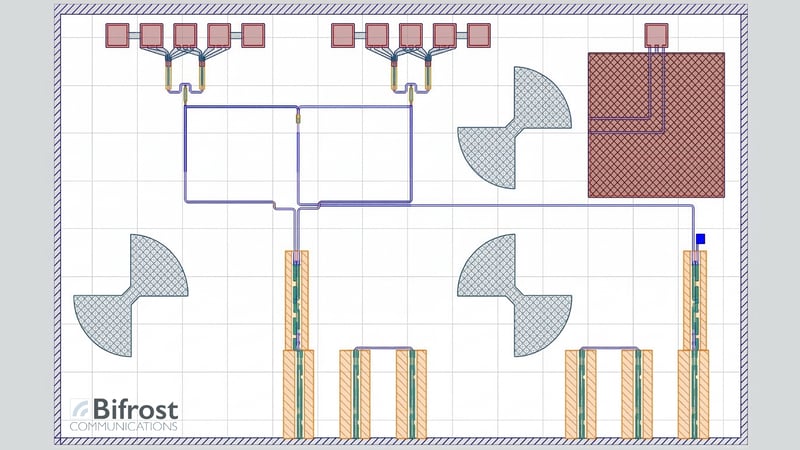
At the center of this technology is Bifrost’s QC-ROSA (Quasi-Coherent Receiver Optical Sub-Assembly), a receiver module that integrates a photonic integrated circuit (PIC) with electronic signal-processing hardware. Incoming optical signals are coupled from the fiber into the PIC, mixed with a local oscillator, and detected using balanced photodiodes. Achieving this functionality on a single photonic chip requires precise device design, careful system integration, and manufacturing-ready layouts.
To accelerate development and prepare the design for fabrication, Bifrost adopted the integrated design workflow provided by PhotonForge and Tidy3D.
The Challenge
Designing the QC-ROSA PIC required multiple optical components, such as edge couplers, multimode interferometer (MMI) splitters, and photodiodes, to operate together with high efficiency and precise phase control. Traditionally, engineers would design layouts in one tool, simulate optical devices in another, and verify circuits in yet another environment. These fragmented workflows often introduce data-transfer errors, slow down iteration cycles, and increase the risk of costly tape-out failures.
For Bifrost, developing a new receiver architecture required a faster, more integrated design approach.
The Solution
Bifrost adopted PhotonForge as the central platform for their photonic design workflow. Within the Photonic Canvas, engineers could perform layout design, device simulation, and circuit verification in a unified environment. This eliminated the need to constantly transfer data between tools and allowed the team to move efficiently from system concepts to fabrication-ready layouts.
A key component of this workflow was the integration of Tidy3D, Flexcompute’s GPU-accelerated electromagnetic solver. With Tidy3D, Bifrost engineers simulated complex components such as 2×2 MMI couplers and photodiode coupling structures with significantly faster turnaround times than traditional CPU-based simulations. The ability to run high-accuracy simulations quickly allowed the team to iterate rapidly and optimize device performance early in the design process. 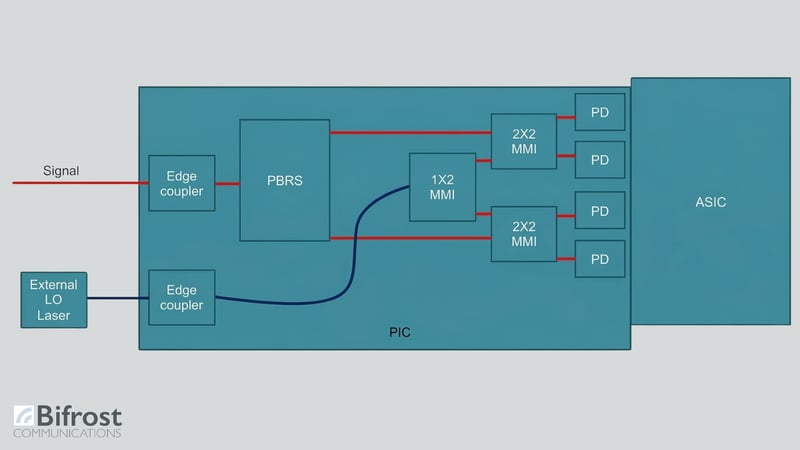
PhotonForge also supports foundry Process Design Kits (PDKs), enabling engineers to design directly with validated manufacturing rules and components. By incorporating fabrication constraints from the beginning, Bifrost ensured that their photonic circuit could move smoothly from design to foundry tape-out. The platform further enabled system-level verification, allowing the team to simulate how incoming optical signals interact with the local oscillator and propagate through the full receiver circuit before fabrication.
Results
Using PhotonForge and Tidy3D, Bifrost successfully developed a fabrication-ready PIC layout for its QC-ROSA receiver. The integrated workflow enabled faster design iteration, accurate device simulation, and early verification of the complete photonic system.
Miguel Carro Temboury, Senior Optical Design Engineer at Bifrost Communications, highlighted the impact of the platform:
“We believe that PhotonForge is the right approach to photonic circuit simulations. It allows us to accurately simulate components with the powerful Tidy3D engine and seamlessly integrate them into circuits and layout. This opens up new options for our designs and also saves a lot of time.”
This collaboration demonstrates how integrated photonic design platforms can streamline the path from concept to manufacturing, helping companies bring next-generation optical technologies to market more quickly and reliably.
.png)
Simulating a Quantum Photonic Chip Using PhotonForge
.png)
Foundry-Ready Active Design with PhotonForge
SUBSCRIBE TO RECEIVE
UPDATES
Stay up-to-date with the latest news and thought leadership in
multiphysics simulation technology.