
While Reddit isn’t a platform I spend much time on, every so often I’ll jump on at the end of the night and scroll through a few communities relevant to my interests and work. One of them is the CFD community. While I don’t add much value there myself, it’s an important way for me to stay up to date on the industry, the questions people are asking, and the challenges they’re facing.
And it doesn’t take long to notice a pattern. My feed is consistently filled with posts like the screenshot below. And sure, I cherry picked one of the funnier ones I've seen, but the point still stands.

It's always questions about how to clean a model and why a mesh is failing. I’m sure you get the point and not to belabor, but here's a dump of quick ones I found after scrolling through for less than 5 minutes.


It's Not About CFD
At some point, it starts to stand out. Most of the discussion isn’t really about CFD. It’s about fixing issues that delay the actual process of CFD.
There’s clearly a problem with the process and way things work.
And to be clear, this isn’t me dismissing the importance of clean geometry or high-quality meshes. Accuracy depends on it. Stability depends on it. Everyone understands that.
So yes, you can argue that the time investment, the effort, and even the extra learning required to prep a model for simulation is justified.
But at the same time, it’s hard to ignore how much of the workflow is centered around this step. And more importantly, how normalized it has become.
Why Have We Accepted It and Moved On?
It’s not something people push back on. It’s just assumed. Luckily the reddit community is filled with helpful people, so a lot of comments will flood in helping the person and giving them guidance on what to change, adjust, or look into as an alternative solution.
 Probably leaving that person stuck like the Daily Struggle meme, having to decide whether to spend more time on manual cleanup or shrink wrapping.
But the underlying problem is never addressed. Instead of questioning it, you plan around it. And that’s really what stood out to me scrolling through those posts. Not just that people are asking these questions, but how consistent they are. Different users, tools, and applications. Same underlying issue.
To be fair, this isn’t a problem that’s been completely ignored.
There have been great products built to help address this. Some very successful businesses have been built around geometry preparation and meshing. Entire workflows, tools, and areas of expertise exist just to make this step more manageable. And they’ve made a real impact.
But these advancements treat one symptom at a time, not the problem as a whole.
Even with the best tools, this step can still take hours, days, or even weeks depending on the model. It still requires expertise. It still involves iteration. And it still sits outside of the actual simulation itself.
Which makes it hard not to ask: with everything else becoming faster, more intelligent, and automated in CFD, why does this step still operate the same way?
There Should Be a Different Way to Think About This
What if there was a different way? Not a better tool for preprocessing. Not a more efficient workflow to learn. But a completely different approach.
One that doesn’t require you to become an expert in geometry cleanup or wrapping methods. One that removes the manual effort entirely. One that takes the guesswork out of your hands and moves it into the system itself. A system built by industry veterans and experts.
Where you can take any raw, dirty model and upload it directly, and instead of preparing it step by step, the system analyzes it, understands what you’re trying to simulate, and automatically reconstructs and prepares it for simulation.
Basically, an intelligent geometry system.
If that sounds unrealistic, it’s only because of how long we’ve accepted the current methods and processes as normal. But that acceptance is starting to break.
This is the idea behind Geometry Intelligence.
From Geometry Preparation to Geometry Intelligence
Geometry Intelligence is a different way of thinking about geometry in simulation workflows. Instead of treating preprocessing as a separate step, it treats it as something the system should understand and handle directly.
It shifts geometry from something you have to fix, clean, and manage… into something the system can interpret and prepare for you.
At Flexcompute, this is exactly the problem we’ve been focused on. That’s why we introduced GeometryAI. GeometryAI is an AI-powered geometry intelligence platform built around this concept.
You can think of it as an AI agent that absorbs all of the preparation work required to perform simulation.
How Geometry Intelligence Works
The goal isn’t to make geometry preparation faster. It’s to remove it as something you have to think about at all.
This doesn’t change the importance of high-quality geometry or meshing. Those still matter. What changes is how you get there.
GeometryAI uses proprietary neural reconstruction algorithms to consume imperfect CAD files, understand the underlying topology you intended to build, and create a clean simulation domain.
-
Fault-Tolerant — Interprets raw, dirty geometry, including gaps, overlaps, and disconnected surfaces
-
3D Intelligent — Reconstructs the object in 3D, recovering the true shape from fragmented or inconsistent surface data
-
Spatially Aware — Reasons about spatial relationships in imperfect CAD to form a valid simulation domain, even when parts are misaligned or incomplete
.png?width=6000&height=1200&name=Untitled%20design%20(39).png)
Instead of relying on accumulated expertise, that knowledge is built into the system itself.
Geometry Intelligence in Real Simulation Workflows
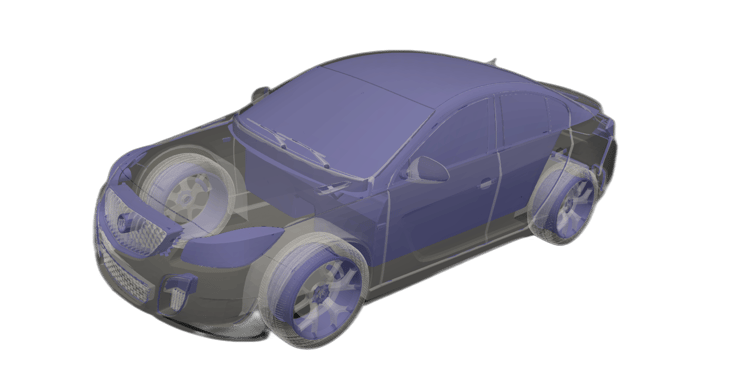
To show how this works in practice, we’ll walk through a real automotive example. The model shown below contains a mix of intended design features, such as panel gaps, along with geometric defects like intersecting grille components.
.png?width=675&height=380&name=Untitled%20design%20(38).png)
GeometryAI directly ingests this model, interprets and maps the geometry, and extracts the outer mold line for an external aerodynamic simulation. The internal bodies and faces that are suppressed during this process are shown in blue.
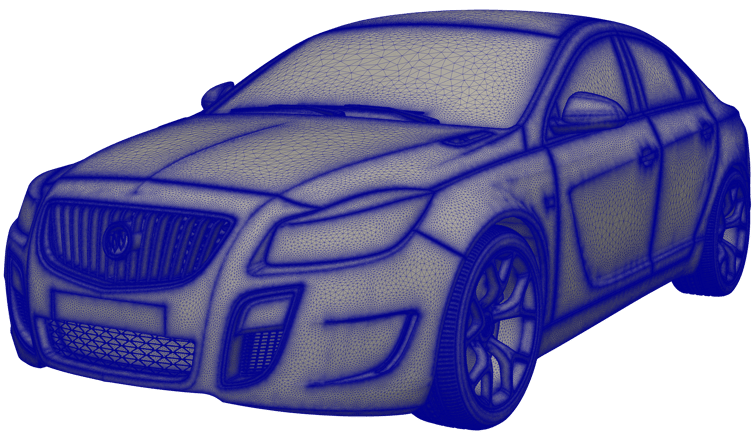
 From this, a watertight, manifold representation is automatically created, enabling high-quality meshing. In this example, the final surface mesh contains approximately 2 million nodes, with a volume mesh of roughly 223 million nodes.
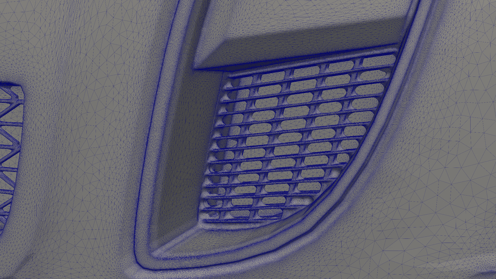
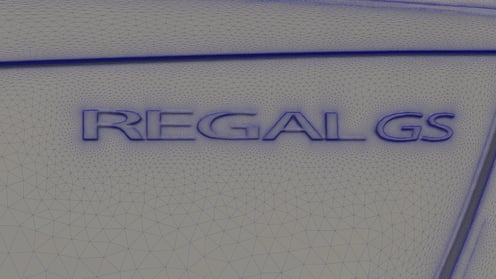
 As we zoom in on the surface mesh, fine geometric details are accurately captured, preserving small and complex features without misinterpreting the underlying topology.
What Geometry Intelligence Changes
This fundamentally changes how geometry preparation is approached in simulation workflows. Instead of planning around it, working through it, and iterating on it… it becomes something that’s handled for you. So instead of asking how to fix a model so it can run, you can focus on work that actually matters.
For something that sits in front of every simulation, it’s surprising how long we’ve treated it as just part of the process.
You shouldn’t have to plan around geometry preparation or absorb the time and cost that come with it. If you’re ready to move past geometry preparation and focus on the work that actually matters, request a demo of GeometryAI below.

.gif)
.png)