Andrej Karpathy's autoresearch has attracted a lot of attention lately. The idea is simple: give an AI agent a research question, a code editor, and the ability to run experiments, then let it iterate autonomously. Hypothesize, code, run, analyze, repeat.
The framework is general. Any problem where an agent can propose a design, evaluate it against a figure of merit, and learn from the result fits this pattern. Photonic device design is a natural match: you have a geometry to define, a simulation to run, and a metric to maximize. The loop of "tweak geometry → simulate → check performance → iterate" is something photonic engineers do every day, often spending weeks on a single device. So we got curious: can AI agents do this autonomously?
We built a lightweight framework inspired by autoresearch, using Tidy3D as the simulation engine. The project is just a few files: an instruction document defining the device target and design constraints; a design.py that the agent edits to define geometry; fixed scripts for simulation, geometry preview, and design rule checking (DRC); and a journal plus results log that serves as the agent's long term memory across context window compressions. The agent is then told to perform the design iteratively. Then we can just press go and walk away.
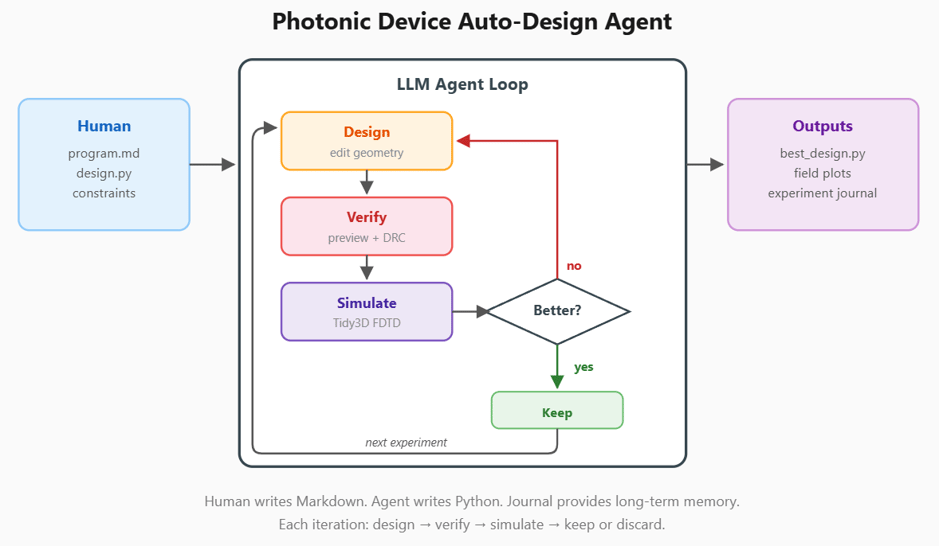 Workflow diagram for the autonomous photonic design agent.
The Y Splitter Challenge
First test: design a low-loss 1×2 Y splitter on 220 nm SOI at 1550 nm, maximum 10 µm device length.
The agent started from a baseline linear taper that splits abruptly into two waveguides. 9.8% total transmission. Terrible, but that's the point of a baseline.
It first tried an MMI splitter, sweeping width and length to find the optimal self imaging condition. This reached 68%, but the agent noted that coupling in and out of the rectangular MMI section was the bottleneck and that 10 µm was too short for the optimal MMI length.
It pivoted to a blunt tip Y junction with sine profile S bends: two waveguides starting with a DRC compliant 150 nm gap, curving apart over 8 µm. This reached 73%.
The breakthrough was what it called a "belly taper": a sine shaped bulge in the input taper that widens beyond the split width (~1.4 µm, about 2.8× the waveguide width) before narrowing back. This preconditioning region lets the optical field split symmetrically before hitting the gap. Performance jumped from 75% to 94% in one move.
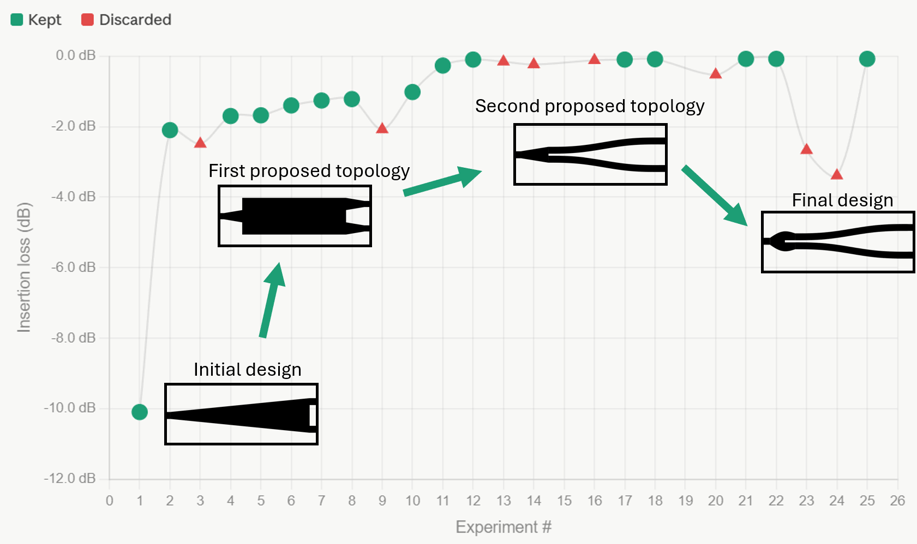 Insertion loss (dB) of a 1×2 Y-branch splitter over 25 design iterations. Green circles denote kept designs; red triangles denote discarded ones. Starting from a simple linear taper at −10.1 dB, successive refinements through MMI geometries, blunt and parabolic Y-junctions, and belly-taper parameter sweeps converge to −0.08 dB (98.2% transmission) by experiment 25.
From there, hundreds of FDTD simulations in batch sweeps: belly width, taper length, bend length, gap size, profile shape, S bend curvature. It tried raised cosine bends, asymmetric bellies, double belly harmonics, presplit channels, wider arms, and integrated junctions, logging each failure with a specific lesson.
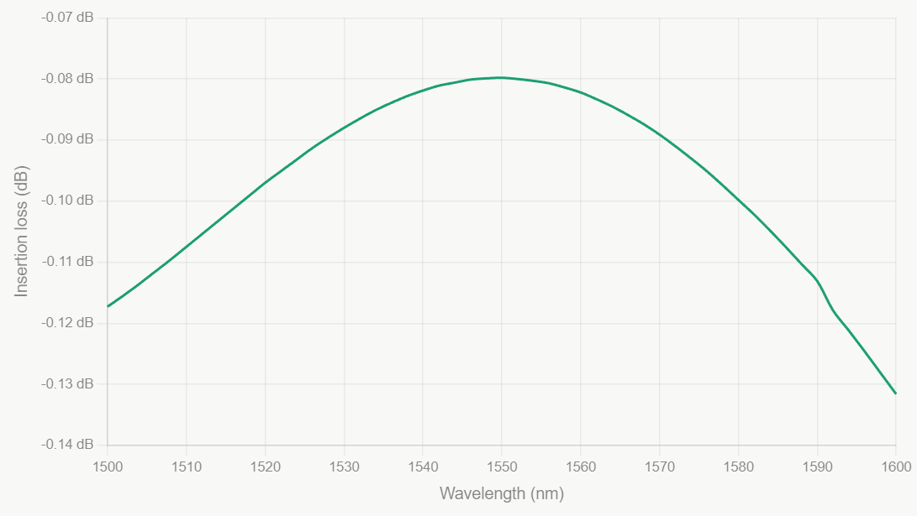
Insertion loss of the final design across the C-band.
The final design achieves 98.2% transmission, i.e. 0.08 dB insertion loss. The agent also confirmed convergence across grid resolutions and simulation times. It correctly identified that the remaining ~1.8% loss is limited by the 150 nm DRC minimum gap at the split point, a constraint only relaxable through different fabrication rules or inverse design. All decisions were made by the agent without any human instructions.
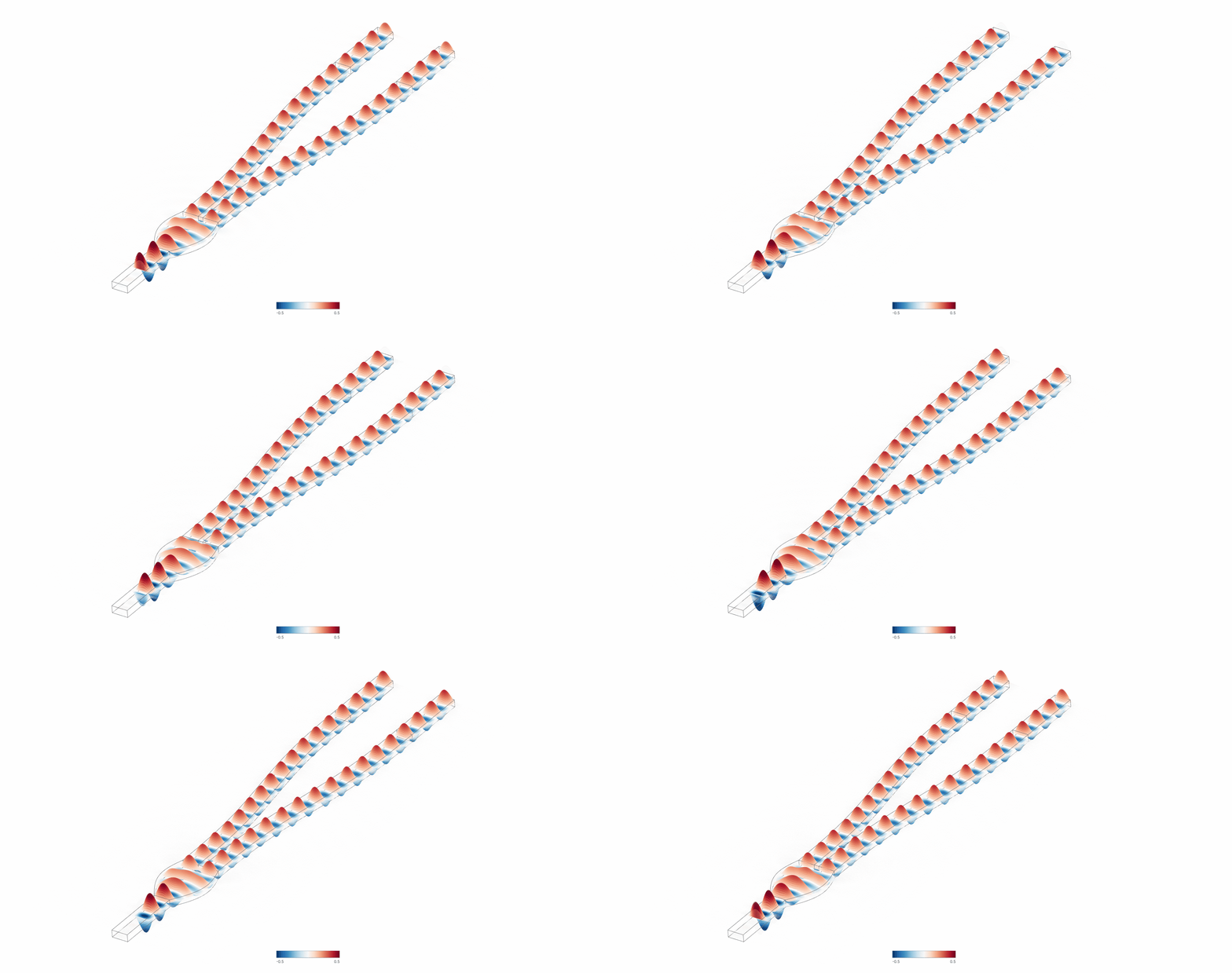
Animation of the light splitting.
Looking Ahead
Is this a groundbreaking design? No. Experienced engineers have designed Y splitters with similar performance, and the belly taper Y junction is a known concept.
But the agent arrived here on its own. Starting from a blank slate linear taper with no photonic splitter knowledge in its instructions, it searched literature, explored MMI and Y junction topologies, discovered the belly taper through experimentation, and optimized it through hundreds of sweeps. No human suggestions. A few hours of wall clock time.
Now imagine this running at scale: massive cloud compute, dozens of device types in parallel. Y splitters, demultiplexers, polarization rotators, grating couplers, ring resonators, modulators, detectors. The agent never tires, never forgets a failed experiment, and context switches between devices effortlessly.
We think the future of photonic design looks less like an engineer tweaking parameters for weeks, and more like writing a one page spec and handing it to an agent that returns a DRC clean, foundry ready design by morning. The creativity doesn't disappear; it moves up the stack, from "what should the taper width be" to "what device should we be building."
We're just getting started. Stay tuned for additional Agentic Photonic Design blogs in the near future.
In the meantime, read the engineering deep dive blog or access the Photonic Device Auto-Design Agent Github repo.